Repository navigation
Potential INF in LNCC loss #1868
Description

Describe the bug
The current implementation of LNCC loss https://github.com/Project-MONAI/MONAI/blob/master/monai/losses/image_dissimilarity.py comes from DeepReg.
However, recently in DeepReg, we encountered INF loss, due to a negative variance at certain voxels. The variance should be zero, but somehow it became around -1e-5 and sometimes it eventually caused INF.
The fix in DeepReg is
- First normalize the kernel so that the sum of the kernel weights equals 1. For some reason, this makes the variance be around machine error (-1e-11) and by adding an EPS, we will not encounter INF anymore.
- We've increased the EPS from 1e-7 to 1e-5, as under mixed-precision, we think 1e-5 is safer.
- Further, we clip the variance to zero, so that the variance must be >=0 in following calculation.
Unfortunately, I could not provide some simple tests to reproduce the inf error (due to the difficult debugging in TensorFlow).
More details are in
Activity
YipengHu commentedon Mar 26, 2021
FYI @tvercaut
tvercaut commentedon Mar 27, 2021
I haven't looked at the code but a scenario like the one you describe arises frequently if you are using a naive algorithm to compute the variance, e.g. something like:
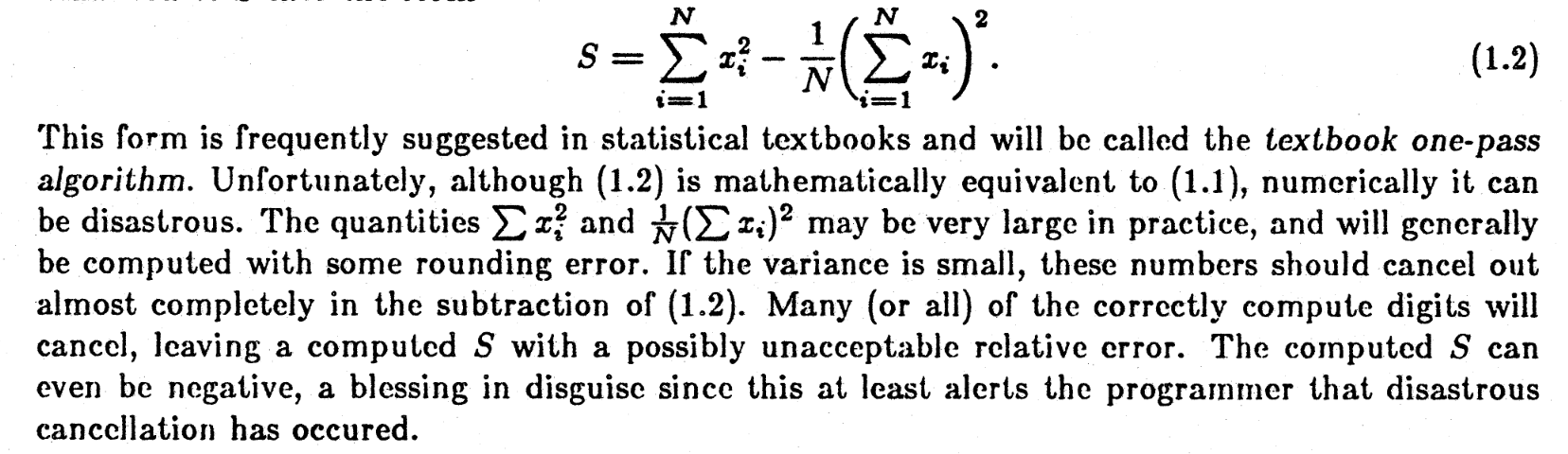
∑x² - (∑x)²
While correct from a mathematical standpoint, a naive computation of the variance is numerically unstable. You can either use a 2-pass algortithm or or slightly more involved online algorith:
https://en.wikipedia.org/wiki/Algorithms_for_calculating_variance
I would assume that pytorch uses a stable algoruthm for this by default
https://pytorch.org/docs/stable/generated/torch.var_mean.html
but if not, this would need to be raised upstream.
mathpluscode commentedon Mar 27, 2021
Thanks, @tvercaut
In LNCC case, we are calculating weighted variance for each voxel via Convolution. Thus, the online algo mentioned in wiki might not be an option :( I may need to dig further if there are more detailed explanations for the instability.
Regarding the bias/unbiased, this will not solve the stability issue as we are adjusting the variance by a constant without changing the sign? But still good to correct the variance.
tvercaut commentedon Mar 27, 2021
The online algorithm (Welford) might be an overkill anyway here, see e.g.:
numpy/numpy#6231
A basic two-step approach is typically enough:
μ=(∑x)/N
σ²=(∑x-μ)²/(N-1)
mathpluscode commentedon Mar 27, 2021
Cool, then we will do this. Gonna try to find some reference to support the claim that
∑x² - (∑x)² is not safe
tvercaut commentedon Mar 27, 2021
The wikipedia link I referred to points to this article:
Can't think of a more definitive support for this :)
wyli commentedon Mar 28, 2021
came across a similar issue a while ago in the batch norm/tf.nn.moments, may need to make sure it's using a high precision for the intermediate values: https://github.com/tensorflow/tensorflow/blob/85c8b2a817f95a3e979ecd1ed95bff1dc1335cff/tensorflow/python/ops/nn_impl.py#L1330-L1344
mathpluscode commentedon Mar 28, 2021
Currently, DeepReg does not support mixed precision yet. So the problems occurred under float32. But indeed, we should enforce float32 for this variance/mean.
wyli commentedon Apr 30, 2021
fixed by #1915, please reopen if needed